

Table of Contents
Lighting is the soul of a room. It sculpts volumes, reveals textures, and dictates the atmosphere, and when you want to transform a space, wall sconces offer some of the most surprising potential.
Far from being mere light sources, they act as architectural jewels that punctuate walls and bring the finishing touch to a decor. Yet, their potential is often underestimated.
This complete guide is designed to help you choose your wall fixtures. From essential technical criteria like the IP rating to style recommendations, including common mistakes to avoid, get ready to see your walls in a new light.
Choosing a wall sconce depends above all on its function. The desired lighting effect is the first criterion to define in order to create the perfect atmosphere.
Direct-lighting sconces project a targeted beam of light, often with a precise diffusion angle. They are ideal for functional needs: lighting a countertop, a reading corner, or framing a bathroom mirror. This type of wall fixture is perfect for defining zones and drawing attention to specific elements. A model like the Tub sconce is an excellent example.
Conversely, indirect-lighting sconces diffuse light toward the wall or the ceiling. They create a soft halo and a soothing atmosphere, perfect for general ambient lighting. This wall light reduces shadows and glare (low UGR), and gives an impression of space. It's a preferred choice for living rooms and bedrooms, where visual comfort comes first. The Danoise collection illustrates this approach well.
This type of sconce, often equipped with a glass shade, filters the light to distribute it uniformly. It's an excellent compromise that offers visual comfort and balanced brightness. An interior wall sconce with diffuse light is versatile and finds its place in almost every room, from hallways to living spaces. The Marguerite sconce is a particularly thoughtful example.
Beyond style, several technical criteria are crucial for making an informed and lasting choice, especially in the Quebec regulatory context.
Light intensity, measured in lumens, determines the amount of light emitted. For ambient lighting, 100 to 300 lumens per sconce is enough, while a reading zone will require 400 to 500 lumens. Color temperature, in Kelvin (K), defines the hue of the light.
The CRI indicates a light source's ability to faithfully render colors. A CRI above 90 is essential for the colors of your decor to be perceived naturally.
In a bathroom, safety is paramount. The ingress protection (IP) rating is a standard that classifies the level of sealing of a fixture. In Quebec, it is essential to respect electrical safety zones. For installation near a shower or a bathtub, an IP44 rating is the minimum required.
The ability to adjust light intensity is a major asset. Opt for LED wall sconces that are compatible with a dimmer. This will allow you to adjust the atmosphere of a room with a single gesture. Always check the fixture's compatibility with your dimmer system.
All fixtures sold in Canada must be CSA-certified (or equivalent such as cUL or cETL). This certification guarantees that the product has been tested and complies with the electrical safety standards in force in Quebec, established by the Régie du bâtiment du Québec (RBQ).
The positioning of your sconces is as important as choosing the model. A well-planned installation optimizes visual comfort and the harmony of the room.
Location | Recommended Installation Height | Pro Tip |
Bedroom (headboard) | 8 to 12 inches above the shoulder (seated) | Make sure the switch is accessible from the bed. |
Living room | About 71 inches from the floor | Coordinate the height with frames and other wall elements. |
Hallway | Between 67 and 71 inches, spaced 8 to 10 feet apart | Creates a safe and welcoming lighted path. |
Bathroom (mirror) | On each side of the mirror, at eye level (approx. 65 inches) | Avoids unflattering shadows on the face. |
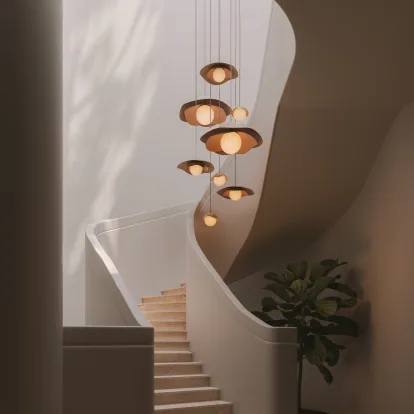
Stairway | On a diagonal, following the slope of the steps | Place them lower than in a hallway to properly light the steps. |
Here are three common mistakes that can undermine a lighting project:
For a custom project or personalized advice, feel free to request a consultation with our experts. Our team will be happy to guide you so you can bring your vision to life without missteps.
Investing in good lighting is a wise choice. Here are a few suggestions for every budget:
It is entirely possible to find a designer wall sconce of good quality without breaking the bank. In this price range, prioritize clean designs and durable materials. A product from the Danoise collection perfectly combines simplicity and elegance.
With a more comfortable budget, you can access bolder pieces and nobler materials. This is the territory of brass finishes and sculptural shapes. A sconce from the Pivoine collection, featuring lacquered metal petals, is an excellent example.
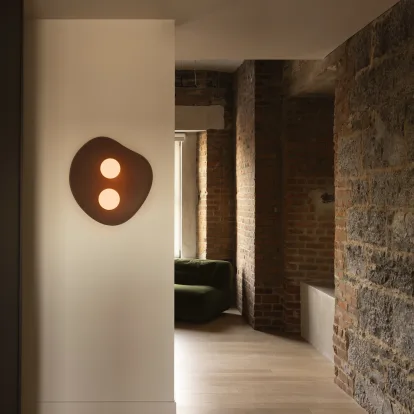
For a high-end investment, prioritize sculptural pieces that become the focal point of the room. The Chrome Nopal 2405-2 embodies this approach with its organic silhouette inspired by the nopal cactus and its striking chrome finish. This wall sconce stands out for its precise metalwork and strong architectural presence, ideal for a contemporary living room or a sophisticated entry hall.
The year 2026 confirms the return to basics with noble materials and organic shapes. Brass, bronze, and natural stone dominate. Designs become more sculptural, transforming the original wall sconce into a work of art.
Integrated LED wall sconce technology is now the standard, offering durability and design refinement. It's an eco-responsible choice, as Hydro-Québec points out in its recommendations. The distinction between integrated LED and replaceable bulb is important: the former offers greater design freedom, while the latter allows you to change the bulb easily.
Choosing the wall sconces that suit your space is an approach that combines practicality and creativity. By mastering the technical aspects and embracing strong stylistic choices, you transform a simple wall into a true expression of your uniqueness. It's an invitation to personalize your interior with pieces that have a story, made right here in Quebec.
Making the right choice means ensuring lighting that reflects who you are and that will last for years. Take the time to explore the possibilities.
Discover our complete wall sconce collection to find inspiration and the fixture that will enhance your space.
Integrated LED wall sconces offer an exceptional lifespan (often over 50,000 hours), reducing maintenance. Their compact format allows designers to create thinner and more original shapes, free from the constraints of a standard bulb. In addition, they are very energy efficient, which translates into savings on your electricity bill.
Yes, but the fastening must be appropriate. For hollow walls (drywall), specific anchors are needed. For concrete, a hammer drill is required. You also need to distinguish hardwired sconces, connected to the electrical system, from plug-in models that connect to an outlet. When in doubt, the advice of a certified electrician is always recommended.
If your sconce doesn't have an integrated LED, choosing the bulb is key. For warm light, prioritize 2700K. For functional lighting, opt for 3000K or 4000 K. Always check the maximum wattage supported by the fixture and prioritize LED bulbs for their energy efficiency and longevity, a winning choice for your wallet and the environment.