




Table of Contents
The dining room is much more than just a place for daily meals. It's a warm gathering spot, a place for sharing precious moments and celebrating special occasions. The dining room light fixture is the true centerpiece that sets the tone for this convivial space and creates the ambiance for your meals with family or friends.
A well-chosen light fixture can transform a simple dining room into an elegant and welcoming space that invites conversation and sharing.
In this complete guide, we'll help you choose dining room lighting suited to the table at the center of the room. We'll cover the appropriate types of fixtures, the right proportions and heights, and the principles of balanced lighting that encourages conversation among guests.
Dining room lighting is naturally centered around the table, which is the focal point of the room. Choosing the main fixture is therefore essential and must be done carefully to create the desired atmosphere.
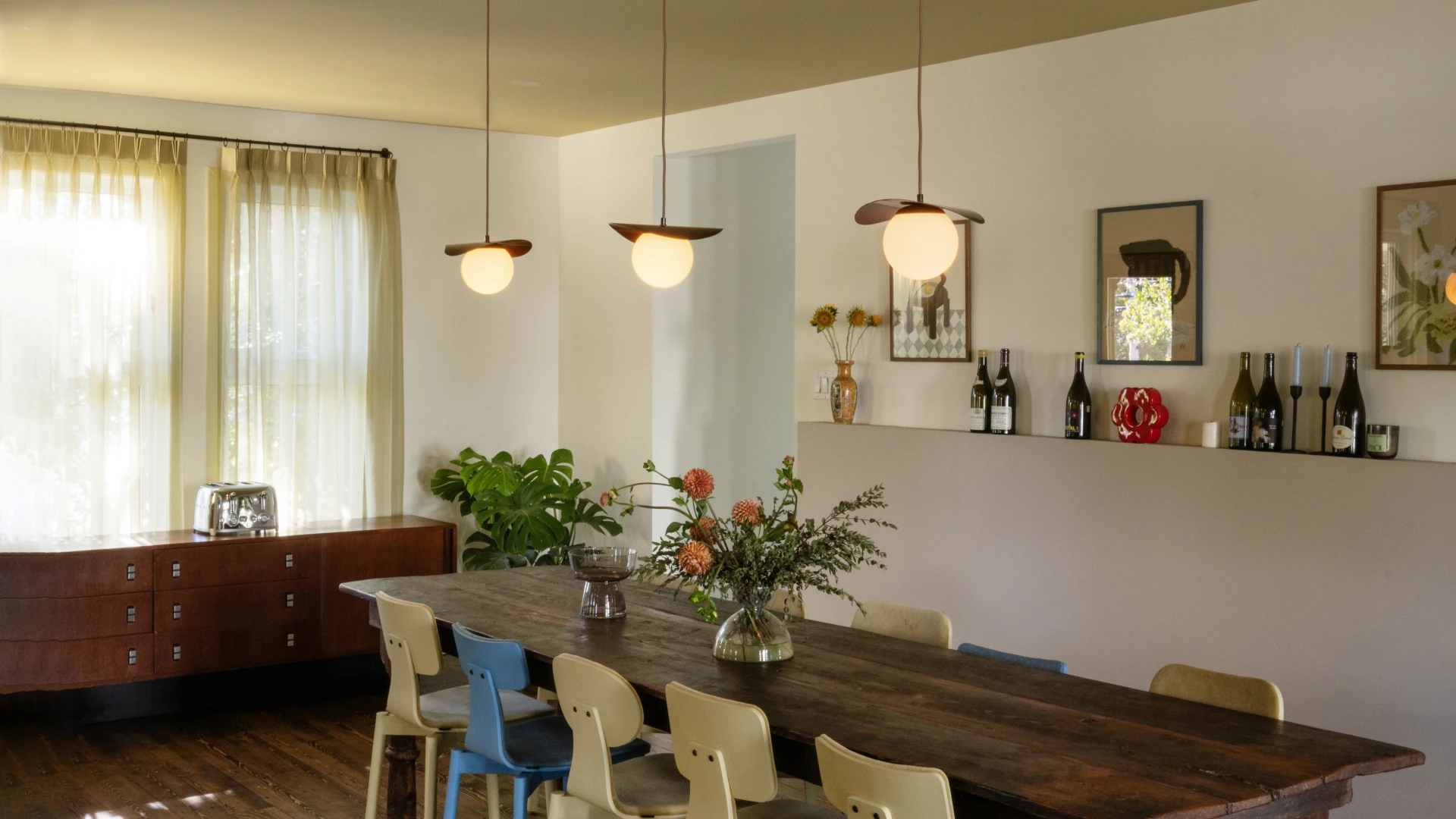
Ideal for rectangular or oval tables, linear pendant lights provide uniform and balanced lighting along the entire length of the table. Their elongated design naturally follows the proportions of the table and creates an elegant visual harmony.
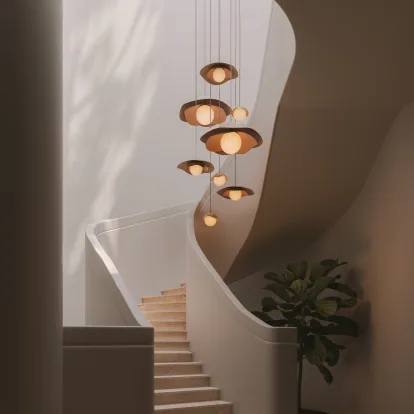
A classic chandelier or an artistic grouping of several pendant lights creates a striking focal point that brings character and personality to your dining room.
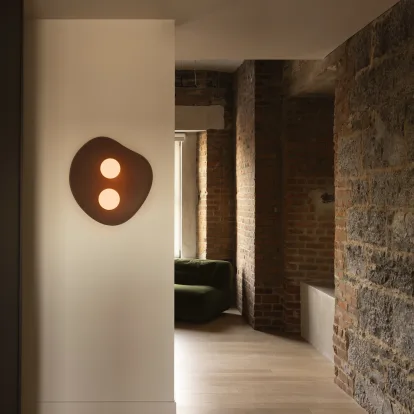
In addition to the main fixture, elegant wall sconces or a sideboard lit by refined table lamps can add visual depth and a soft ambient light that complements the main lighting.
For perfect visual balance and optimal comfort, follow these few simple but essential rules:
To design a custom lighting plan perfectly suited to your dining room, request virtual guidance.
The choice of fixture depends above all on the shape of the table. A well-proportioned fixture lights the meal surface uniformly while creating visual balance in the room.
Table Shape | Recommended Fixture Type | Why |
Rectangular table | Linear pendant light or 2-3 aligned pendant lights | Allows light to be distributed along the entire length of the table |
Round table | Central chandelier or round pendant light | Creates a balanced focal point at the center of the table |
Square table | Compact chandelier or single pendant light | Provides uniform light without overloading the space |
Large table | Composition of multiple pendant lights | Allows the entire meal surface to be lit |
The style of the dining room light fixture must first and foremost match the dimensions and shape of the table. A model that is too discreet can appear unbalanced, while a fixture that is too imposing risks visually overwhelming the space and undermining the comfort of guests.
Materials and finishes are also worth considering. Glass, worked metal, and matte finishes diffuse light in a balanced way while maintaining a visual presence consistent with the table. In the dining room, the style of the fixture is never an isolated choice: it is always guided by the table and by the meal experience.
Find inspiration by browsing our residential projects to discover how different styles fit into real spaces.
In a dining room, accent lighting highlights certain elements around the table, a textured wall, a piece of art, or an architectural detail, while reinforcing the perception of volumes and the visual depth of the space.
Use wall sconces to frame an antique sideboard or a piece of art, or place elegant table lamps on a console to create a soft glow.
Dimmers are absolutely essential in a dining room to create the right ambiance for the occasion. A casual family meal calls for bright and energizing lighting, while a romantic dinner benefits from soft and intimate lighting.
Investing in quality dimmers allows you to instantly transform the atmosphere of your dining room.
With a more limited budget, it is preferable to focus the investment on a well-proportioned fixture above the table rather than multiplying secondary sources. A simple model, properly sized and positioned, is often enough to create impact.
With a mid-range budget, it becomes possible to further refine the lighting by playing with the shape and diffusion of the light. Linear pendant lights or multiple-fixture compositions allow the table to be lit more uniformly, particularly in the case of large surfaces.
A higher budget finally offers greater freedom in the lighting design of the table. Fixtures with worked materials, controlled diffusion, or bolder proportions can become true structural elements of the meal, while maintaining the visual comfort of guests.
At this stage, lighting no longer simply illuminates: it fully supports the experience at the table, from everyday moments to special occasions.
A well-thought-out installation is essential to ensure comfortable and balanced lighting around the dining table.
Centering the fixture relative to the table is essential. It must be aligned with the table's axis, regardless of its position in the room. Poor centering creates visual imbalance and uneven light.
The installation height also plays a determining role. Suspended too high, the fixture loses its impact on the table and unnecessarily lights the surrounding space. Placed too low, it can obstruct the view and undermine visual comfort.
For large tables or compositions of multiple pendant lights, even spacing of the fixtures is essential to achieve harmonious balance. .
Choosing a dining room light fixture is a delicate balancing act between visual impact and practical functionality. By selecting a fixture with the right proportions, layering different light sources to create depth, and using dimmers to adjust the ambiance, you'll create a welcoming and elegant dining room.
Ready to transform your dining room into an unforgettable space? Contact us to benefit from the personalized expertise of our lighting advisors.
The most recommended fixture for a dining room is generally a pendant light installed directly above the table. It effectively lights the table surface while visually structuring the space. The choice of model depends above all on the shape and dimensions of the table, rather than on the room as a whole.
The ideal height is generally between 28 and 36 inches above the table surface. This distance ensures proper lighting without obstructing the view between guests.
For a large table, it is preferable to opt for a linear pendant light or a multiple-fixture composition. This solution helps distribute light uniformly across the entire surface of the table. It avoids under-lit zones and better respects the visual proportions of the overall composition.
Yes, installing a dimmer is strongly recommended in the dining room. Dimming improves visual comfort, reduces glare, and makes the lighting more versatile throughout the day.
Yes, using multiple pendant lights is particularly suited to long or rectangular tables. The fixtures must be evenly spaced to ensure uniform light diffusion.