




Table of Contents
The kitchen is one of the most central rooms of the home. It's a space for culinary creativity and shared moments where the whole family gathers. As a result, the kitchen light fixture must be efficient for daily tasks, safe to prevent accidents, and aesthetic enough to create a pleasant atmosphere.
Good kitchen lighting can transform your culinary experience, making meal preparation more enjoyable and less stressful.
In this complete guide, we'll explain how to design efficient and safe kitchen lighting, covering the types of fixtures suited to work zones, the right heights to avoid shadows, the styles compatible with intensive use, and the essential technical criteria for a functional kitchen.
Kitchen lighting must be designed around the task and adapted to the different work zones. Unlike other rooms, the kitchen requires more intense and more targeted lighting to ensure safety and comfort during meal preparation.
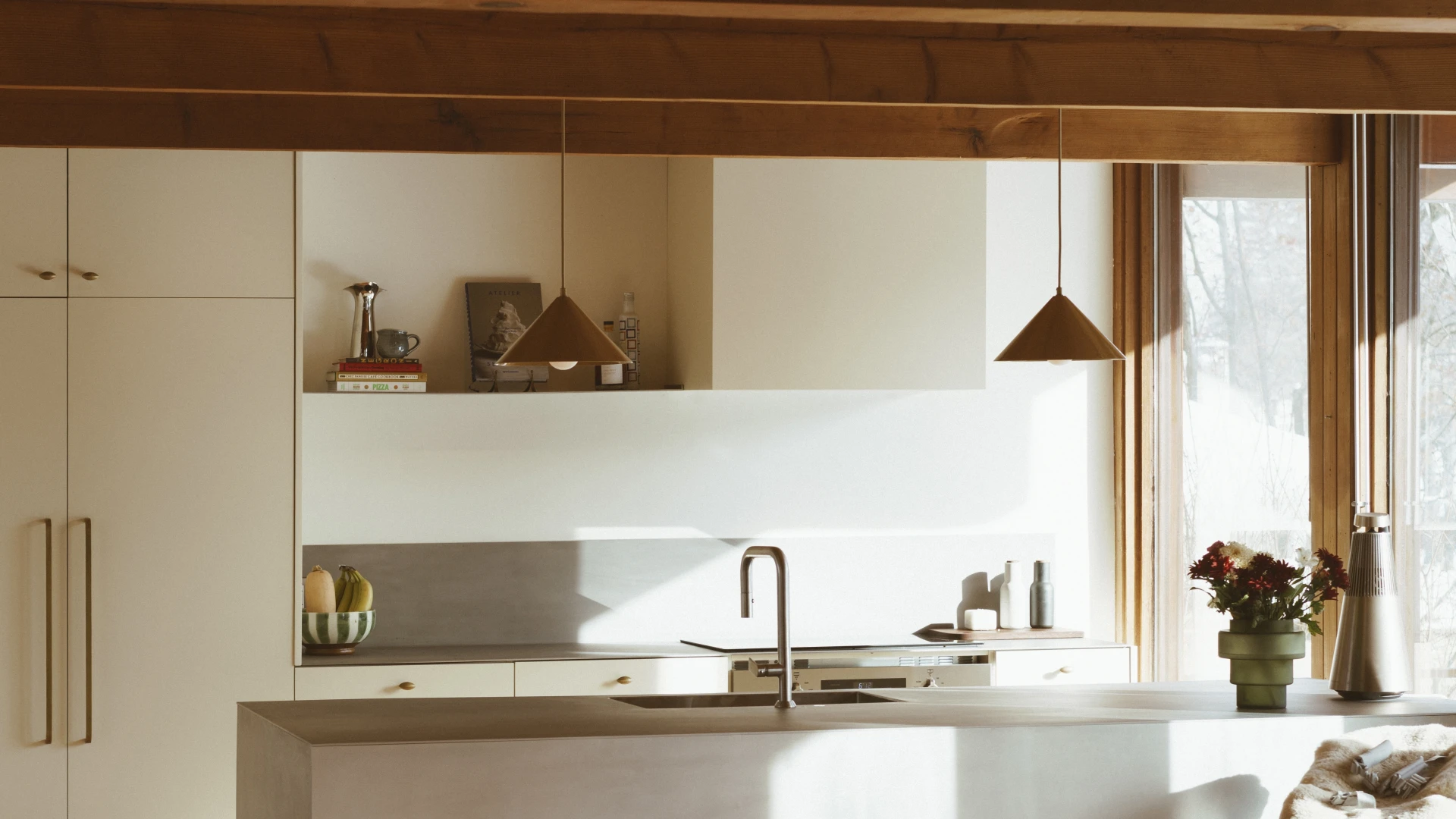
This is the centerpiece and focal point of modern kitchen lighting. One or more pendant lights above the island visually define the space, create a well-lit work zone, and provide the direct lighting essential for food preparation.
LED strips or light bars installed under the upper cabinets eliminate annoying shadows and perfectly light the countertops. It's one of the most cost-effective investments in kitchen lighting.
Ceiling lights provide the general lighting of the room and ensure good overall visibility in every corner of the kitchen. They are especially important in kitchens without windows or with little natural light.
Properly sizing your kitchen light fixtures is crucial for safety and visual comfort:
For a custom lighting plan perfectly suited to your kitchen, request in-store guidance.
In the kitchen, the style of a light fixture must first and foremost meet practical constraints. Models that are too ornate, heavily textured, or difficult to clean quickly become unsuitable in an environment exposed to heat, humidity, and splashes.
Clean styles, with simple lines and smooth surfaces, are generally recommended in kitchens because they require minimal maintenance. Matte or satin finishes reduce unwanted reflections on work surfaces, while closed or semi-closed shades limit the accumulation of dust and grease.
Industrial or contemporary-inspired fixtures naturally find their place in the kitchen, provided you prioritize resistant and easy-to-clean materials. Here, the style must remain in service of functionality: a well-chosen kitchen light fixture improves visibility and safety without visually overloading the space.
Explore our collections to find the style that perfectly harmonizes with your kitchen.
Accent lighting adds a touch of sophistication and personality to your kitchen. Use LED strips inside glass-front cabinets to highlight your dishware or pottery, or install small spotlights to light a decorative niche or a collection of objects.
Accent lighting transforms your kitchen into a space that combines functionality and aesthetics. In addition, choosing Energy Star-certified fixtures can significantly help reduce your energy consumption and electricity bills.
Safety is paramount in a kitchen where water and electricity coexist. Make sure that fixtures installed near the sink or the stove have an appropriate ingress protection (IP) rating. A minimum IP44 rating is recommended for these high-risk zones. This rating ensures protection against water splashes and guarantees your safety on a daily basis.
Type of Kitchen Light Fixture | Role in the Kitchen | Examples |
General lighting | Provides overall brightness and allows safe movement in the kitchen | Ceiling lights, recessed lights, LED panels |
Task lighting | Lights work zones directly for safe cooking | Under-cabinet lighting, pendant lights above the island |
Accent lighting | Highlights specific elements and adds an aesthetic dimension | LED strips in glass-front cabinets, lighting for niches or shelves |
In the kitchen, the budget should be allocated as a priority to zones where light has a direct impact on safety and efficiency. With a more limited budget, the most relevant investment concerns under-cabinet lighting. Continuous, well-positioned lighting on countertops immediately improves the precision of your movements and reduces shadow zones, even if the general lighting remains simple.
When the budget allows, the next step is to strengthen the general lighting and the lighting of key zones, such as the island or the peninsula. Properly sized pendant lights and higher-quality diffusing ceiling lights make it possible to achieve more uniform and less tiring light on a daily basis. At this stage, choosing light sources with a good color rendering index becomes particularly important.
A higher budget finally allows you to optimize the entire lighting system. Integrating more durable solutions, dimming adapted to different times of day, or fixtures designed to withstand intensive use improves the overall performance of the kitchen. Here, the goal is not the decorative effect, but the reliability, consistency, and long-term safety of the lighting.
Careful installation is essential in the kitchen to ensure optimal visibility on work surfaces and to limit the risks associated with shadow zones. Unlike other rooms, lighting here supports specific tasks that require well-oriented and consistent light.
Finally, since the kitchen often includes humid zones or areas exposed to heat, complying with electrical standards and choosing suitable fixtures are essential. Professional guidance helps validate the layout and connections before final installation.
The kitchen requires precise and safe lighting. Certain mistakes can undermine visibility and efficiency.
Choosing the right kitchen light fixture relies on the balance between performance and aesthetics. By combining general lighting for visibility, task lighting for comfort and safety, and accent lighting for style, you create a kitchen that is both functional and elegant on a daily basis.
Need help transforming your kitchen with professional lighting? Contact us to benefit from the expertise of our specialized advisors.
Countertop lighting must be direct, uniform, and free of shadow zones. Fixtures installed under cabinets are the most effective, as they precisely light the surface used for food preparation. Placed at the front of the cabinet units, they improve visibility and reduce the risks associated with imprecise movements.
The lighting output of a kitchen depends on its surface area and the number of work zones. In general, you should aim for a higher intensity than in living areas, especially on preparation surfaces. It is preferable to distribute the output among several sources rather than using a single overly intense fixture.
A good color rendering index allows you to accurately perceive food, which facilitates preparation and cooking. A high CRI improves the distinction of textures and shades, thereby reducing visual errors. In the kitchen, an insufficient CRI can distort the appearance of food and undermine precision.
Yes. The island often serves as both a preparation zone and a versatile space. It requires targeted lighting, generally provided by well-positioned pendant lights. The rest of the kitchen should benefit from uniform general lighting to ensure consistent visibility across all surfaces.
In a kitchen, it is essential to choose fixtures designed to resist humidity, heat, and splashes. Models with an appropriate protection rating are recommended near the sink or the stove. This guarantees the durability of installations and limits long-term electrical risks.